
Beginner's guide to building your first scene
BDSM 101 + step-by-step prep to becoming someone new tonight

What does BDSM stand for and how is it different than a fetish? How is submissiveness different than powerlessness? What’s the difference between BDSM and abuse?
You might want the latest lingo so you can put a word like “Daddy” in your dating profile with confidence, whatever your gender.
Or you might be wondering what it means to want to be worshipped, owned, or utterly undone by someone who finally sees your appetite for what it is.
If this feels like one of those cooking blogs where you want the recipe but have to scroll through the author’s life story first, I understand your haste and your annoyance. This is, after all, BDSM 101. There is much to learn. And I promise you, the recipe is coming (or, at the very least, a food reference).
The journey starts one step before any of the questions above can be answered.
Here is how this is going to work:
First, my story, because I was once you: a beginner.
Then the language, because BDSM as a sub-culture really could have its own dictionary (although we can’t seem to agree on definitions these days):

Then the playbook: how to bring up your kinky desires, how to negotiate, how to guide the night through a scene, and how to land safely on the other side with aftercare.
Who this is guide for?
Consenting adults. Curious ones. People in relationships wondering how to bring this up with their partner in a way that doesn’t put you ten steps back in the closet. People who read one too many articles that treated kink like a crime scene or a punchline and knew it wasn’t the whole shebang. Everything here assumes two people who both want to be here, both sober enough to mean what they say, and both free to stop at any moment for any reason or no reason at all.
This guide is education, not therapy, and it is not medical, legal, or psychological advice. It is not a substitute for a class or a professional when you move into higher-risk play. If either of you has a history that makes this feel unsafe rather than exciting, that is worth talking through with a professional first.
Part 1/9 · How I Got Here
A stranger’s two-word reply and a one-way ticket to Berlin opened a door I didn’t know I had locked within me.
I was walking down the hallway of my mind, opening door after door.
What was calling me was also what I was rejecting within myself. As far back as I can remember, no matter how many awards I won, teams I led, or rungs I climbed on the career ladder, I sensed there was something missing.
My journey into BDSM began in the backseat of an Uber, Googling “how to be a dominatrix” on my way to the airport to fly to Berlin for the first time with a man I barely knew.
In writing this guide I have had to go back to that mindset, where words like “sissification” and “cat o’nine tails” were sounds that made little sense. I wouldn’t have understood the philosophy of a dungeon if I walked face first into a St. Andrew’s Cross.
Dominance? Wasn’t that patriarchy. Submission? Wasn’t that for 1950s housewives or dog training. Play is something we outgrow, right? Pain should be avoided. Pleasure is an orgasm achieved through penetration. That is the place I was starting from. I grew up in a small, Christian town on the outskirts of British Columbia, Canada. Forgive me for my ignorance.
Nearly a decade ago, there I was, standing outside my house at the end of a third date, after he’d opened the car door for me. This man had a grey fog around him. His intentions I couldn’t pinpoint and he still hadn’t made a move, making him all the more ambiguous. Most would have interpreted him as mysterious, but I was annoyed.
I can usually read people quickly, by which I mean I pay attention to what they say between their words and fill in the blanks myself. In the days of online dating, of which I was a reluctant and short-lived participant, I’d show up late to the meeting spot, usually a restaurant and right around dinner time (hello free meal!), and watch them from afar for a few minutes.
What did they do at the table when they were alone? How did they shift when I approached?
But this man, well, I couldn’t seem to seduce him nor be rid of him. He sat still at the table, patiently waiting, neither smiling nor frowning. I hated not being in control. Why had he not tried to kiss me by the end of that third date?
When I got home that evening, I called it off. I texted him that it was best we didn’t see one another again, to which he replied a lukewarm “ok...”
Then I texted my friend, in the blushing folly of my squandered seduction: “I finally got rid of that guy, I’m pretty sure he’s gay and just doesn’t know it.”
But I sent that text to him by accident.
When the ellipses popped up, you know, those little bubbles of thought that can make your throat constrict like awaiting a guillotine, I thought to myself: you deserve whatever this person says, because you, Nicolle, are an asshole.
But the two short words he replied changed my life:
Go on.

All the gears rotating in my system seemed to click into place. My brain was pierced with an icepick of knowing that shot white light across my vision for a millisecond, and I knew, with complete certainty, that he wanted to be humiliated, that he liked it, and that I was perfectly suited from a lifetime of seemingly disparate experiences to hold him in that feeling.
In the hallway of my mind, I heard that click and looked down to see a cellar door unlocked. I had been looking in the wrong places. I had been looking where power was already visible: careers, mirrors, and family circumstance. I had been wandering the mainstream wondering why no one seemed to be like me.
Where I hadn’t looked was in the shadows. I hadn’t looked at the outline of things I could sense but couldn’t see. I had ignored the profane in the sacred, denied my own longing like watching plump desert clouds pass by overhead, and shovelled prayers like dirt between my legs to bury my shame.
For the next two hours, we had an honest conversation about who he really was. As he typed, I fervently researched the words he was saying. Terms entered my consciousness that I had never heard but intuitively sensed had history: bimbofication; findom; shibari; CBT (and I’m not talking cognitive behavioural therapy, people).
Finally he wrote, “Can I take you somewhere you’ve never been before?”
I agreed, assuming that meant a new restaurant in Toronto. Then I checked my inbox and found a ticket to Berlin.
So, as I was saying, I was in the backseat of an Uber on the way to the airport. No matter how many blog posts I read about wielding a flogger, or the difference between a flogger and a whip, I knew the best place to start was within. I needed to begin from a grounded place of self-mastery and connect with all the ways I already was what I was seeking. I wanted to be a Dominatrix.
I put my phone away and made a pact that I would dedicate the rest of my life to learning the hard skills of BDSM, but the starting point had to be my love for myself and others. How could everything I do perpetuate more love in the world? How could I help someone love themselves, especially the parts they thought were unloveable? How could this set me free, make me whole? How could I teach others?

Imagine you are standing in the hallway of your own mind. You’ve opened the cellar door. You can see the steps leading down into the darker aspects of your psyche. What waits in the darkness? Is it something to fear? Is it furry? Is it a part of you that longs to serve? Does it growl and purr at the thought of tying up helpless prey? Does it want to be painted in bruises? Can you embrace it? Can you love it? The darkness blooms and sings, you’ll see.
The day you meet your own gaze in the darkness is the day you will understand BDSM.
First, the elephant in the dungeon
People unfamiliar with BDSM frequently perceive it as abusive. They conflate the eroticization of intensity with harmful intent, and assume sadists indiscriminately impose their will on masochists, who in turn take pleasure in their own suffering as victims of trauma, often from childhood.
Like any group of people who cluster around a common interest, there are predators who exploit the conviviality of such communities.
But in reality, research has repeatedly found that BDSM practitioners score the same as or better than the general population on most measures of psychological wellbeing (one widely cited Dutch study found practitioners were less neurotic, more conscientious, and more secure in their relationships than the control group, which will surprise nobody who has watched a rope top pack a first-aid kit).
For most people, BDSM is one choice from the vast menu of sexual possibilities, engaged in for fun.
Beyond the fantasy of the roles that players establish, BDSM is a co-created realm where participants feel replenished, enlightened, and aroused rather than depleted, taken advantage of, or harmed. Challenging feelings might arise. Harm is not, and should never be, the intention. It is then that a case can be made for abuse.
Rather than rejecting the darker aspects of your desires (the urge to inflict pain or the longing to feel it, the satisfaction of a perfectly executed scene or the relief of relinquishing control), BDSM invites you to play with the aspects of yourself hidden in the shadows.
Through consensual erotic interactions, which need not include physical pain or power exchange at all, you can experience a depth of self-acceptance with repercussions that extend well beyond the act itself.
It is also fun, hot, and frequently silly. Not all BDSM has to be for healing, and not all healing can be done through BDSM. But these practices give our taboo affections a structured place to be celebrated instead of repressed. With a defined start, progression, and conclusion, BDSM in all its layers is another way to say: I see you. I accept you. I love you. To yourself.
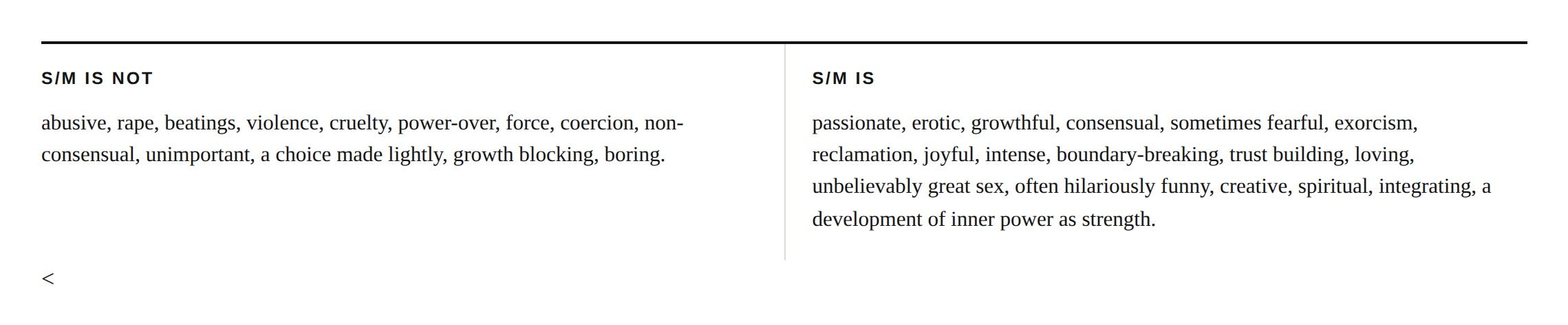
Charles Moser and JJ Madeson, in their book Bound to Be Free, put the distinction better than anyone:
Part 2/9 · The Language
BDSM
BDSM stands for Bondage and Discipline, Dominance and Submission, Sadism and Masochism.
Kink vs. fetish
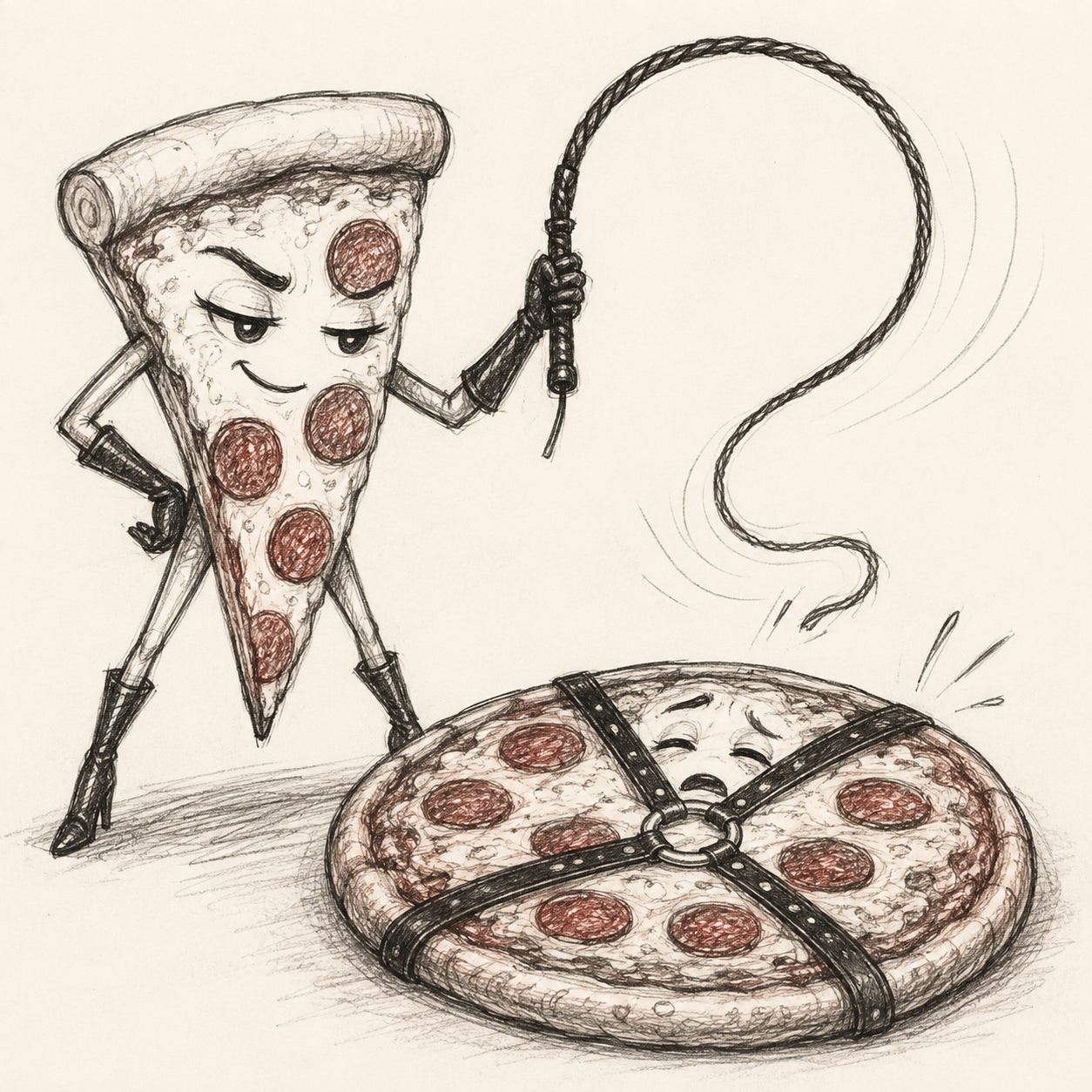
Think of it like pizza.
Most people order cheese or pepperoni. That’s vanilla sex. You want hot honey or anchovies. Totally edible, just not what most people order. That’s kink: foot fetishism, voyeurism, exhibitionism, role play, sensation play, tantric practices, cuckolding, BDSM and dozens more. It’s a broad category. It just means your taste runs outside the standard menu.
So when someone says "I'm kinky” or “I’m into kink,” they haven't told you which pizza they like. They've just told you they don’t only order cheese or pepperoni.
A fetish is when you specifically cannot enjoy the pizza without one particular topping. Not “I really like anchovies.” More like: no anchovies, no appetite. Without them, the whole meal falls flat. No anchovy orgasm for you, sir! That’s a fetish. It’s not a preference, it’s a requirement.
So! Put simply:
If you enjoy something “extra” in sex, as in “not the norm,” and it adds to the experience, that’s a kink. (Pssst, seems like more people might be kinky than ya think).
If you need a specific thing during sex to get turned on at all, that’s a fetish.
Maybe some examples would help?
Someone who enjoys being blindfolded because it makes sex feel more intense? Kink.
They can have great sex without the blindfold, but the blindfold just makes it 10x better.
Someone who genuinely cannot get aroused unless their partner is wearing latex? Fetish.
The latex isn’t a fun addition. Without it, sex isn’t sex. It’s just a couple of bodies flopping around and sweatily sloshing together without generating any electricity.
Someone who loves role-playing as strangers because it adds novelty? Kink.
Someone who can only get turned on by feet, specifically, and nothing else does anything for them? Fetish.
Bondage and Discipline (B/D)
Physical restraint to amplify excitement. Rope, a bandana, handcuffs, a belt, Velcro. Bondage often runs alongside discipline, a punishment-and-reward dynamic (think teacher and student) where the rules exist mostly for the pleasure of enforcing them.
Dominance and Submission (D/s)
The consensual exchange of power. One partner takes charge, the other hands control over. It can be a single instruction across the dinner table or a standing arrangement that colours a whole relationship. It runs on trust, not force.
Sadism and Masochism (S/M)
The enjoyment of giving or receiving pain or discomfort. A sadist derives pleasure from delivering intense sensation. A masochist enjoys receiving it, or being made deliciously uncomfortable, or being “forced” to do something they secretly relish. The pain can be physical (a spanking), psychological (an interrogation scene), or both. Sadists and masochists experience these pleasures inside consensual scenes. Outside of consent, it is not S/M. It is just violence. In many ways, a sadist is not a sadist without a masochist, only sadistic. And a masochist is not a masochist without a sadist, only a victim.
Switch
Someone who fluidly inhabits both Dominant and submissive roles. Switches remind us that power is not a personality type. Their ability to move between roles speaks to the nuance of control and the empathy required to hold either end of it well, and to allow one’s natural response to the presence of another (or the day of the week, or the time of month, or the city the dungeon is in) to determine how they behave.
Player
Anyone actively involved in BDSM activities or scenes, in any role. If you run your first scene this week, congratulations: you are a player. Business cards are optional.
Scene
A way to enter and exit play. A scene is a specific period of time during which participants engage in consensual BDSM activities, usually pre-negotiated, with agreed-upon roles, limits, and safewords. The scene ritualizes the interaction. It creates a container where you can embody an aspect of yourself that might otherwise stay hidden, and, crucially, it ends. The word emphasizes the temporary and performative nature of what happens inside it.
Play party
A communal, organized space where the curious and the experienced explore together, sometimes in view of others. Good parties are environments with meticulous rules: dress codes, codes of conduct, consent monitors, sometimes themes. You do not need to attend one to do any of this. But it is worth knowing they exist, and that they are usually better-run than most parties these days.
The five components: what makes it S/M and not abuse
In a 1984 study, researchers Weinberg, Williams, and Moser found that sadomasochistic interaction usually contains five components. I include them because they draw the line between BDSM and abuse:
Dominance and submission. One partner takes control and the other gives it up, and both read that imbalance as the point of the thing. It is the axis the other four turn on.
Role-playing. An exaggeration of the expectations surrounding the chosen roles: master and slave, teacher and student, captor and spy.
Consensuality. A voluntary agreement to enter the play and honour its limits. We cannot call spousal abuse SM because SM is consensual and abuse is not. Just as the difference between intercourse and rape is consent, the distinction between SM and true violence is also consent.
Sexual context. The presumption that the activities have sexual meaning, even when nobody orgasms and nobody undresses. Religious flagellation is a different phenomenon entirely, though the equipment overlaps more than either community likes to admit.
Mutual definition. The participants agree on the parameters of what they are doing, whether or not they call it SM.
Part 3/9 · The Ask

Before any scene, there is the smaller, scarier scene: telling your partner you want this. Most couples never get past it. They circle the idea for years, drop hints, delete the search history, and go back to the version of sex they already know. A few things that help:
Name the desire outside the bedroom. Not mid-sex, not at 1 a.m., not while one of you is holding a knife while making dinner. Try it on a comfortable walk. A long drive. An event on the calendar with a distractionless amount of quality time.
Come prepared with something specific. “I want to try kink” is like saying “I want to try food.” But if you say something like: “I want to blindfold you on Friday and spend twenty minutes making you guess what’s touching you” it registers more as an invitation. Vague makes your partner do the imagining.
Lead with the feeling, not the gear. “I want to feel completely in charge of your pleasure for one night” lands differently than a box with a leather harness. The gear is a delivery mechanism for the feeling. Why you want to feel a certain way is more powerful than any toy.
Give them a real exit. “If this isn’t for you, tell me, and nothing changes between us” only works if you mean it. A reluctant yes is worse than a clean no. You want a partner, not a hostage with manners. It might be jarring for your partner to hear that you’d like to explore a kink. They might internalize feelings of “am I not enough?” It’s important to be connected to your desire, your kink, your ask of them (especially if that ask is permission to explore elsewhere). Try thinking back to when you first realized you were kinky. This could be a childhood memory that activated something in you. This might help soften the feeling of it being something new if it’s connected to a feeling of, “Oh, you’ve always been this way. Okay, let’s talk about that.” If it is a new discovery, own that too. Be as connected to your truth as possible, and give your partner plenty of grace to receive that truth. You can’t force anyone to understand your desire for kink. Trust the process, know it might be a slow conversation with many touch points, and move at the pace of the nervous system that needs to make the most adjustments to feel safe. Perhaps suggest seeing a kink-conscious therapist to help guide the conversation if it feels like a stalemate.
Start at fifty percent. Whatever intensity you’re imagining, run the first scene at half of it. You can always escalate, but you cannot un-ring a bell.
Ready to try a scene for yourself?
I’ve put together six scenes of varying intensity and sensation, running 20 minutes to a full evening, so you can play in your own bedroom this week if you want to.
→ Get your scene guidance here
(Payment via PayPal. Digital product will arrive in your inbox within the hour).
Part 4/9 · Think of a Scene Like a Story
A scene has a beginning, a middle, and an end. It is a bounded stretch of time where the two of you agree to a different set of rules. Inside it, one of you has more control than usual and one of you has less. Outside it, you are equals again.
Without the boundaries of a scene, you are just being intense with each other and hoping it lands. With it, you can go much further than you think, because you both know exactly where the edges are. (I’m speaking specifically to beginners here and not those in 24/7 D/s or M/s dynamics).
1. The negotiation
Before anything physical, you decide together what is on the table and what is not. What you both want to try. What is off limits. How you will stop. This is not a mood killer but it could be considered foreplay. (How hot is it to talk, soberly, about what you really-really want?).
2. The scene
This is the play itself. It follows the plan you made, with room to slow down, check in, and adjust. It is shorter than you expect. Twenty to forty minutes is plenty for a first time. The goal is not to do everything. The goal is to do one or two things well and finish while you still want more.
3. The aftercare
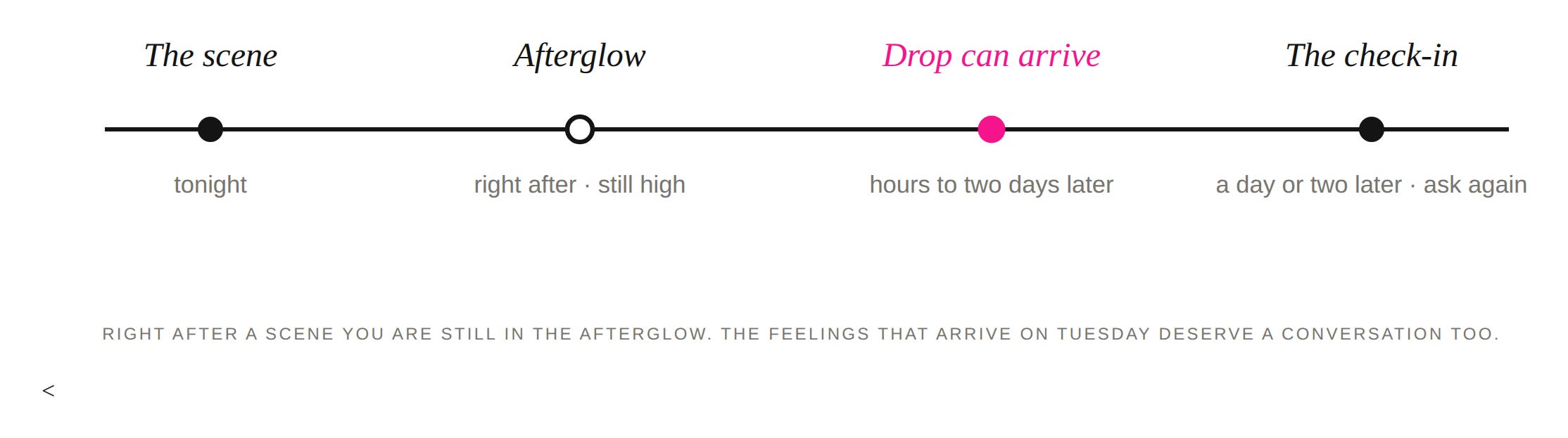
When the scene ends, you come back to yourselves. Bodies change temperature, adrenaline drops, and feelings show up that neither of you planned for. Aftercare is how you close the loop gently instead of leaving one person alone with a crash. Skip it and a good scene can still leave a bad taste. Do it well and even a clumsy first attempt feels like something you did together.
Everything is consensual, and consent can be withdrawn at any moment. A yes at the kitchen table is not a yes forever. The submissive can stop the scene with a single word, and when they do, the scene is over, immediately, with no argument and no disappointment shown. This is not a technicality. It is the foundation. A Dominant who honors the stop word every single time is a Dominant worth trusting with more.
One principle governs everything that follows: a yes can become a no, but a no cannot become a yes. Not mid-scene. If something was off the table during negotiation, it stays off the table tonight, even if the moment feels right, even if somebody begs beautifully. Arousal is a persuasive lawyer and a terrible judge. Deep in a scene, people are open in ways they cannot fully consent from. Save the next level for the next negotiation. The scene you protect tonight is the trust you get to play with tomorrow.
Part 5/9 · The Negotiation
Sitting across from someone while they tell you exactly how they want to be taken apart is one of the most erotic conversations you will ever have. Treat it that way.
Sit down together somewhere neutral. Not the bedroom. You want your ordinary heads for this, not your turned-on ones. Give it at least twenty minutes. Work through the four conversations below in order. This is not a one-time meeting. It is an evolving dialogue that adapts as you grow.
Conversation one: what you each want
Take turns. Each of you finishes this sentence out loud: the thing I am curious about is. No judging the other person’s answers. Curiosity is not a commitment. You are just putting cards on the table. If saying it out loud is too hard the first time, write your three on paper and swap. That counts.
Useful prompts to give you some momemtum:
What kind of experience are you looking for tonight?
What are you hoping to feel?
What do you want afterward: touch, stillness, water, snacks, silence, praise, a blanket, all of the above?

Conversation two: limits
Now the opposite: each of you names your hard limits. A hard limit is a line that does not move tonight, no matter how good things feel. It might be a specific act, a word, a part of the body, an object. The other person’s only job is to hear them and agree to honour them. You also each get soft limits. A soft limit is a maybe. Something you would try under the right conditions but do not want assumed. Name those too, and say what would turn a maybe into a yes.
Cover the discussion about the body while you’re here:
Any injuries or health conditions to know about?
Any places that are off the menu?
Can marks be left, what kind, and where? (Your Monday morning yoga class is a stakeholder here.)
Could anything in this scene be triggering, and if so, what is the best way to care for you?
Are you sober? If not, this waits. (Some people do choose to play while under the influence of psychedelics. I’d be lying if I said that wasn’t true. What I will say: the first time with someone, and many times after, it’s best not to be compromised or intoxicated in any way.)
Conversation three: the stop system
You can negotiate limits in advance, but you cannot prepare for everything. It is impossible to predict how you will feel mid-scene. A safeword is your safety net: a word you would never normally utter during a scene, chosen together beforehand.
Why not just say “stop”?
Because words like stop, no, and please don’t may be part of the dialogue of a scene where the bottom wants to resist or be “forced.” Playful struggle is one of the oldest games there is. So the community borrowed from the traffic light. It works even when someone can barely speak.
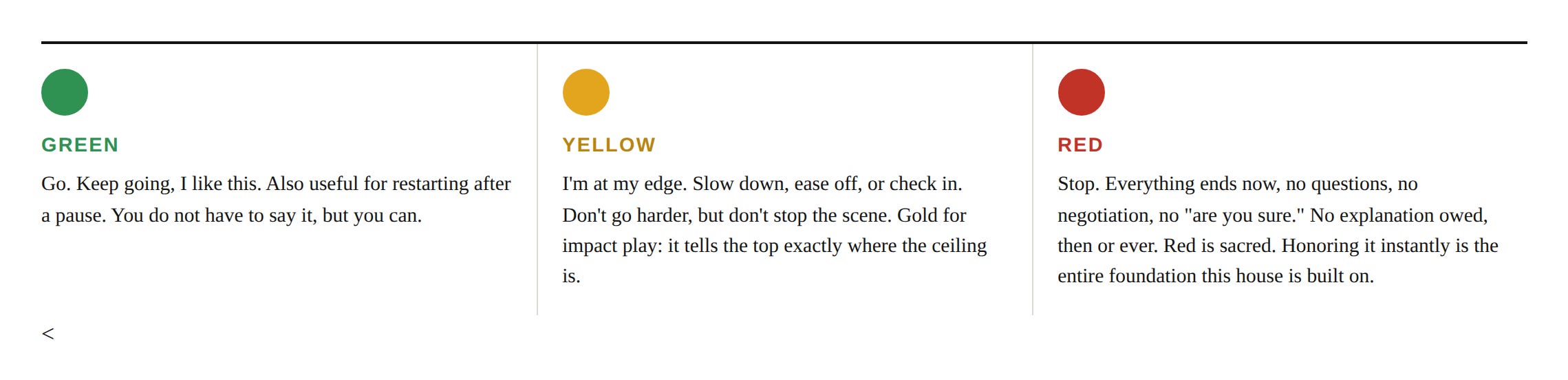
Something most beginners skip: A non-verbal red.
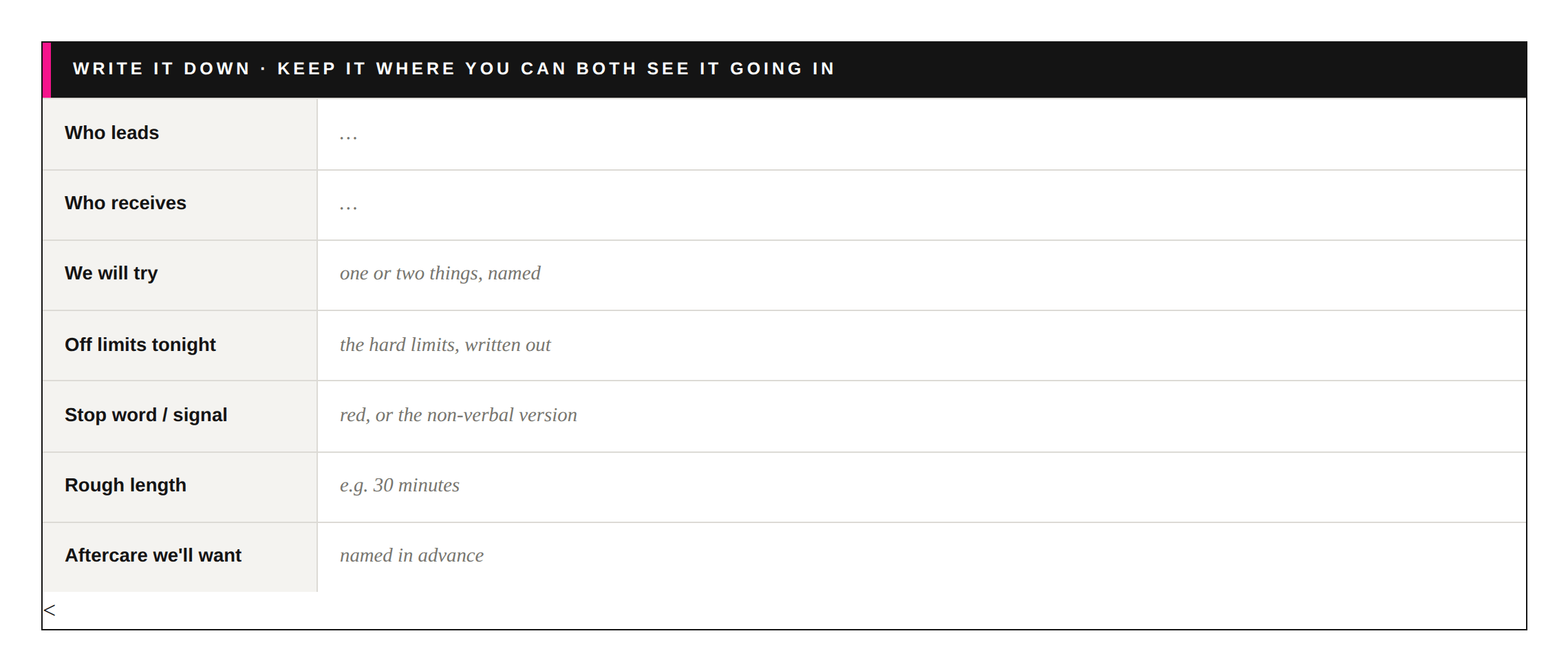
If the submissive’s mouth will be covered or occupied, agree on one now, not later. Dropping a held object works. Three loud taps on the nearest surface works.
Early in the scene, the Dominant should ask for a colour once, when nothing is wrong. It proves the system works and reminds you both it is there. A submissive who has said green once will find red much easier to reach.
Conversation four: how the night unfolds
Now decide, together, what actually happens. Keep it small. Pick one or two things from your want lists that do not cross either person’s limits. Decide who leads and who receives. Decide roughly how long. Decide what aftercare you will want, before you need it, because the person in a post-scene drop is in no state to ask. And if restraint is involved: where are the scissors?
The alphabet soup of staying safe
The kink community has spent forty years refining how to talk about risk, which tells you two things: risk is real, and these people take it seriously. At the same time, cut yourselves some slack while you learn. Everyone’s first flogger stroke looks like they’re swatting a wasp or flapping a bouquet of spaghetti on your exposed derriere. They might hit too hard by accident or call you a name that reminds you of being bullied by 13-year-olds. Good things can happen unexpectedly as much as challenging emotions can arise. Through these mottos, it’s clear that players are trying to avoid causing harm or damage, while acknowledging the risk (psychologically and physically) to engaging in BDSM activities.
SSC / Safe, Sane, and Consensual
Coined in 1983, promoted to articulate the values of a growing community and to make plain, as SM became more visible, that SM was not abuse. It became the motto. A decade later, people began to critique it: did “safe” sanitize SM? Its own originator later clarified that “safe” was always meant as the opposite of careless, irresponsible, or uninformed. It meant doing your homework.
RACK / Risk-Aware Consensual Kink
Introduced in 1999. RACK keeps consent at the center while acknowledging that some practices are inherently risky, and that exploring those edges is part of what draws people in. You make an informed decision, reduce the risks you can, and proceed with eyes open.
PRICK / Personal Responsibility, Informed, Consensual Kink
A newer frame making explicit what RACK implies: every participant is responsible for their own safety, including informing partners of risks, knowing their own comfort, and using their safewords. It does not reduce your responsibility for your partner, but it does make sure everyone, not only the Dominant, is responsible for what happens.
The 4Cs / Caring, Communication, Consent, Caution
More common in 24/7 and total power exchange relationships. This framework deliberately avoids the word “risk,” preferring to name the positives an ethical scene or relationship should contain.
Part 6/9 · The Scene
The intensity arc: open slowly, build in small steps, end on purpose
Do not start at full intensity. Take the submissive’s wrists, hold eye contact, let the shift in the room happen before anything physical does. The first minute is about changing the vibe, not about doing anything. Let them feel the difference in how you are looking at them, speaking to them, or leading them.
Add one thing at a time and watch what it does. A scene is a conversation your bodies are having. Say something, wait, see how they answer, say the next thing. Rushing is the single most common first-time mistake. There is no prize for speed. Watch their breathing. Do they flinch? Moan? Move their hips? Lean in? Smirk? Look away? Fidget? Wiggle their toes? Laugh? Do not falter in guiding them, instead, use their reaction to tease them and take them deeper. You control the pace.
Check in without breaking the spell. You do not have to stop and get serious. A quiet “colour?” whispered in their ear keeps the scene intact while giving them an easy way to answer. Do it early, do it after anything new, and do it any time their body goes still in a way you cannot read. Here are a few other ways to check in without being like, “do you like this?” (Because, honestly, they might not “like” it, but they might want it. Answering a question where their rational mind and body-based desire are at odds will snap them out of the fantasy and subspace).
Try saying:“More, or less?” (Lets them connect to the intensity without stepping outside the scene to explain why.)
“Still with me?” (Soft enough to land during a tender moment, clear enough to need an answer.)
“Give me a sound if this is good.” (Removes the need for words entirely. A moan, a hum, a tap).
“Squeeze my hand once for yes.” (Non-verbal. Works especially well during restraint or when they’ve gone very quiet.)
A hand placed flat in the air and the request, “Move your body to touch my hand if you want to keep going.” (No words from them at all. Their body answers.)
“Tell me where you are.” (Slightly more open than “colour?” but still in-scene. Invites a one or two word answer rather than a debrief.)
The principle under all of them: you are not asking if they like it. You are asking where they are. Those are different questions and the body knows the difference.

Reading a submissive who has gone quiet is part of your responsibility AND theirs. Quiet can mean deep and blissful, or it can mean overwhelmed and frozen. You cannot always tell from outside. So ask. If they answer green, continue. If they cannot answer at all, treat it as yellow, slow everything down, and bring them back toward you until they can speak. Silence because of disassociation is not a compliment. Silence because they are fully surrendered, yes. This is also where the “personal responsibility” comes in on the side of the submissive. Too often, the Dom(me) is blamed if they didn’t perfectly read the sub’s silence to mean disassociated compliance rather than floaty, subby, googley-eyed, mush-brained bliss. The submissive needs to communicate during negotiation if they have or might disassociated. And, if possible in the moment, they need to use their safe word or safe gesture, rather than escaping too far from their body or the situation that it becomes an issue later.
The submissive can feel you hesitate. That is the one thing that breaks the trust faster than any mistake. If something goes sideways, do not panic and do not apologize mid-scene or lose your footing and crumble. Slow down, steady your voice, and stay with them. You can talk about the wobble afterward. You can de-escalate without breaking the scene with uncertainty. You can begin the slow and strategic ending without turning inward and making it about you not landing the perfect line. So what that candle wax got on the bedsheets or the music skipped and ruined the climax of your flogging fantasy. Trust is built on you being able to keep your shit together under pressure and imperfection.
End on purpose and punctual. Did you agree that the scene would last 40 minutes? Perfect. Don’t push it to 90 because you’re hot and horny. And do not let the scene fizzle because you ran out of ideas. Bring the intensity down deliberately, the way you brought it up. Loosen anything restraining them. Move from doing things to them, to simply holding them. The end of the scene is the beginning of aftercare. Agree on a rough finish time before you start, and put a real clock where the Dominant can see it. Scenes distort time. Knowing you have thirty minutes, not the whole night, keeps the play focused and keeps the first time from tipping into too much. Having a set timer (once it goes off, that signals to begin the shift into the end and aftercare) create a time-bound container (scene) without the ending having to rely purely on the Dominant’s awareness (or the submissive’s boredom).
Part 7/9 · Aftercare
What happens after a scene is just as significant as what happens during it. You just took someone apart, now put them back together. Revel in your shared humanity, which is your vulnerability in this moment together.
A scene is like an extraordinary date, a high-flying adventure, a one-of-a-kind experience. One or both of you will likely be flooded with endorphins afterward. You might feel energized and excited, worn out and beat down, or, seemingly inexplicably, both. You may be lightheaded. You may feel like you’ve run a marathon or seen God. Exuberant, meditative, vulnerable, anxious, giddy, confused, transcendent, dumbfounded. All of it is normal. Let the feelings, even the scary ones, wash over you. Take a deep breath.
Aftercare is a check-in process that makes sure everyone feels good about what they shared, and it goes well beyond ice on bruises. BDSM can trigger a rush of chemistry that leads to an emotional and physical “drop,” and that drop visits Dominants and submissives alike.
The first twenty minutes post-scene:
Get warm. Blanket, body heat, whatever you set aside. Cold makes drop worse.
Get water and something small to eat into both of you. Blood sugar is real. Low blood sugar has ruined more afterglows than any argument ever has.
Stay physically close and quiet. No debrief yet. Just contact. Let the bodies settle before the words start.
Say something true that isn’t a review. Just “I’ve got you,” or “that was good,” in a soft voice.
Address the basics too: Do you need the restroom? Do you want to stand up, sit down, move somewhere quieter or more comfortable? Too warm, too cold? Some people want to process the scene immediately.
Be ready to listen, validate, and comfort. Some want sex, making out, or sweet cuddling as their aftercare. Others need a few kind words, a hug, and a lollipop, and they’re on their way. Aftercare is different for everyone. Do not assume you know what someone wants. Ask. (You already asked in the negotiation. This is why.)
Part 8/9 · Subspace and topspace
Subspace
What happens to the person receiving when a scene goes deep enough. Subspace is a documented neurological shift: the body under sustained intense stimulus (physical, psychological, or both) releases a flood of endorphins and, in some cases, produces a dissociative state similar to the one athletes describe as being “in the zone,” except the zone here is warm, floaty, and completely untethered from ordinary thinking. Time distorts. The inner critic goes quiet. The person may feel euphoric, dreamy, unable to form sentences, or just deeply, heavily present in their body in a way they almost never are otherwise. Some people cry. Some giggle. Some go silent and still in a way that looks from the outside like they’ve fallen asleep but is actually the opposite: they are more awake to sensation than they have been in years.
Getting someone out of subspace too abruptly can be disorienting and, in some cases, triggering. This is one of the reasons aftercare is not optional. The landing matters as much as the flight.
Topspace
Less talked about but just as real. It is what happens to the person leading when a scene goes well. The sustained focus required to hold someone’s experience, read their body, pace the intensity, hold the frame, and make decisions in real time produces its own altered state. Some Dominants describe it as a kind of clarity, a narrowing of attention to just this room and this person, where everything outside the scene becomes irrelevant noise. Others describe something closer to a controlled high: focused, sharp, slightly electric.
Topspace is also why Dominants can drop afterward. The intensity was real for both people. A Dom who cares for their submissive through aftercare and then sits alone with the crash is doing it wrong. (I say “wrong” because I’m speaking to beginners here and it’s important to be completely honest about how you’re feeling). Just remember to check in with each other and you’ll have a much better landing.
Part 9/9 · When It Doesn’t Go to Plan - Q&A
Does wanting this mean something is wrong with our relationship?
No. Couples who play like this tend to communicate more, not less. You are about to have a more honest conversation about desire than most people ever have. Plus, isn’t it healthier to explore all sides of yourself? This can be done within the relationship:

What if I like it too much, or not at all?
Both are fine and neither is permanent. This is one night, not a verdict on who you are. You are gathering information about your own bodies. Whatever you find, you get to decide what to do with it.
Do we need equipment?
No. When starting off, your presence and honesty are the most important parts. That can’t be bought or faked. Your hands, your voice, and a scarf or wooden spoon you already own are plenty for a first scene. Skip the shopping. The gear is the least important part and the easiest to add later once you know what you actually enjoy.
How do we know if we did it right?
You checked in, you honoured the limits, you took care of each other afterward. That is right. The specific acts matter far less than the trust. A gentle, careful first scene beats an ambitious, careless one every time. Do you want to keep experimenting? Did you feel something, even if that feeling was unexpected? Right and wrong are harder to define in BDSM beyond “what were your intentions?” and “how was your communication?” As long as you strive not to cause harm, all feelings (yes, even the ones that feel wrong), might mean that it was “right.” The question now is can you be completely honest about the experience? Give yourself some time and space to let that land in your body beyond the intellect and analysis.
What if one of us wants to go further than the other?
Then you play at the pace of the person who wants less, and you talk about the gap with kindness and no pressure. Desire that has to be negotiated is normal. Desire that gets pushed past a no is not play anymore. Consider bringing in a professional to act as a bridge between your experiences.
We tried and it was awkward. Should we give up?
Awkward is the first draft. Nearly everyone’s first scene is clumsy, and the couples who keep going are simply the ones who expected that. Talk about what felt off, change one thing, and try again.
BONUS! 10/9 - More PDFs are coming

This is the first in a series. Which do you want me to build for you next?
Okay, now are you ready to try a scene for yourself?
I’ve put together six scenes of varying intensity and sensation, running 20 minutes to a full evening, so you can play in your own bedroom this week if you want to.
→ Get your scene guidance here
Want an expert guide in the room?
I created Domme on Demand for exactly that.
Private guidance, scene design, and live coaching for couples ready to explore power, surrender, and erotic depth together, with an expert actually there while you do it.
I am a Certified Therapeutic BDSM Educator and a Certified Kink-Conscious Professional, and I work as a practitioner, not a participant. I help you name the desires you do not yet have words for, design scenes built for your specific dynamic, coach you live as you play, and help you integrate what comes up after so it lands in the body and not just the head. The intimacy is yours. I am the guide and trusted voice before the scene, in the room, and/or after. You choose.
Scene Development Package. The full arc in three sessions.
Live Coached Scene. The signature offering. I guide you over live video as the scene unfolds.
The Practice. A monthly container for the couples who want to go deep and keep going.
Coaching for Men. A private one-month track: learning to dominate, or learning to submit.
Bring Me to Your Bedroom. The full arc, with me in the room for the scene itself.
Every engagement begins with a free thirty-minute discovery call, where we find the cellar door and walk through together.
→ dommeondemand.com

Fantastic. Wow. What a treasure trove.
What a gift! This is so thorough and clear thank you